
Alone, Isolated or Lonely? Social Life Beyond the Office
Does remote work make people lonely? This is a question that comes up frequently in public discussions about working from home, usually alongside concerns about isolation, the disappearance of workplace friendships, or the loss of spontaneous conversations with colleagues. The office is often presented as an important source of social connection, and spending less time there is seen as a potential threat to our social lives. Yet in my research with remote and hybrid workers in Bucharest, I often hear people describe their experiences in ways that seem contradictory. They tell me they sometimes feel more isolated since they started working from home, only to insist, a few moments later, that they would never want to return to the office.
This contradiction becomes easier to understand once we distinguish between three experiences often conflated in discussions about remote work. In this post, being alone means simply spending time without other people around. Isolation refers to missing the presence of others, whether or not one has friends and family nearby. Loneliness is different again: the feeling that one’s relationships are lacking or unsatisfying. These do not always occur together. Someone can have a rich social life and still miss the background presence of colleagues during the working day. Yet discussions about remote work often treat them as one problem, to which returning to the office becomes the obvious solution. What I want to suggest is that many of the people I spoke to are isolated without being lonely. What they miss is not necessarily the office, or even their colleagues, but the ordinary presence of other people, which they look for in unexpected places.
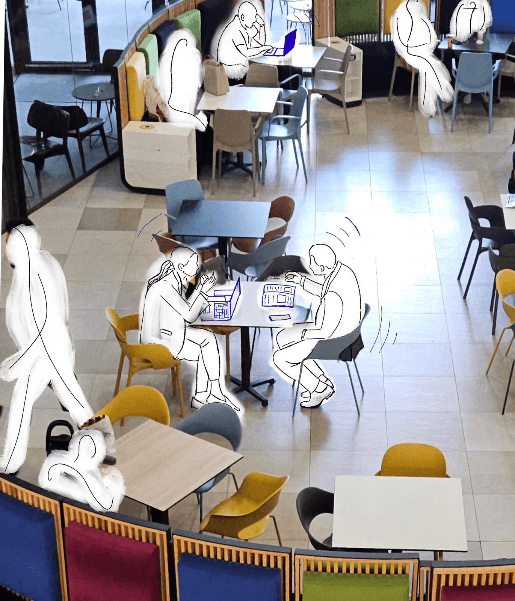
Two brothers I interviewed in Drumul Taberei, a residential neighbourhood in western Bucharest, offer a good example. Both work remotely. One lives with his wife and children, while the other lives alone in a nearby apartment. They spend much of their working time at home, sometimes together at the apartment of the brother who lives alone. They also regularly go to the food court of a shopping mall in the neighbourhood. They had previously tried a coworking space in a local community centre, but neither particularly liked working there. Instead, they preferred the food court, even though it was considerably noisier and had never been designed as a workplace.
They described the sound of people talking, eating and moving around as a kind of white noise, a continuous background that makes working there comfortable. It is also more convenient for stepping outside to smoke. Neither goes there to meet people, make friends or collaborate with other workers. They appreciate having people around without needing to interact with them. After long periods at home, the food court offers something their apartments cannot, even though their friendships and existing social relationships have not suffered from working remotely.
Something similar came up in a conversation with Adriana, who works from home while caring for her daughter. She lives on the ground floor of an apartment building and has arranged her workspace on the balcony, precisely because she enjoys hearing her neighbours talking and the ordinary activity taking place outside. She describes this as a way of feeling life around her, of remaining connected to what is happening beyond her apartment. In winter, when it becomes too cold to work outside, she moves inside, which she finds less pleasant. From the balcony, she does not need to take part in anyone’s conversations or even know who is speaking. The sounds of other people going about their lives are enough.
For both Adriana and the brothers, long periods at home can create a sense of isolation that has little to do with the state of their friendships or the number of people they meet. One can have fulfilling relationships, spend time with friends and family, and still feel suffocated by the absence of other people during much of the working day. The sounds of a food court or a residential courtyard offer something that cannot necessarily be replaced by arranging another meeting with a friend. These experiences have a social dimension, even when there is no social relationship involved.
Sociologist Michael Liegl (2014) describes something similar in his research on mobile workers who deliberately seek out cafés and other public places. The presence of strangers can help concentration, provide a sense of company, or simply make working alone more pleasant. Others become part of the atmosphere of a place, even when they remain entirely indifferent to the person working there.
Urban sociologist Talja Blokland also offers a useful way of thinking about these experiences. In Urban Bonds (2003) and later in Community as Urban Practice (2017), she questions the tendency to understand community primarily through personal networks and close social bonds. Everyday urban life also involves more fleeting encounters and forms of public familiarity, developed through repeatedly seeing the same people in shops, on the street or in other shared places. People can recognise others, develop a sense of belonging and feel comfortable somewhere without forming friendships. But the brothers’ and Adriana’s experiences suggest that even this familiarity is not always necessary. Sometimes the anonymous presence of others, the knowledge that life is happening around us, is enough.
The different ways people experience sociality also become apparent in their changing relationships with the office. Andrei, who has worked for the same company for six years, has developed a small, stable group of colleagues who are also his friends. Since working remotely, they sometimes coordinate their office visits specifically to see one another. He enjoys spending more time alone and does not feel lonelier or particularly in need of more social contact. Seeing his colleagues less often has made their meetings more intentional, without making their friendships any less important. For him, the office has become somewhere he can choose to spend time with people he likes, rather than a place where their presence is taken for granted.
Sorina has a very different relationship with the office. She dislikes going there and does not particularly enjoy her colleagues’ company. Yet during difficult periods, when she is feeling low, she sometimes chooses to go in. She is not looking for conversation or small talk, but finds it better to be surrounded by people than to spend another day alone at home. The office offers some relief from isolation, even when she has little interest in the relationships within it.
Both cases help explain why missing certain aspects of office life does not necessarily mean wanting to return there. The office was never only a place where people maintained relationships with colleagues. It was also where they spent much of their day surrounded by others, whether they liked them or not. Remote work allows some people to become more selective about their relationships, while leaving others missing the ordinary presence of colleagues without necessarily missing the interactions themselves.
For some of the people I interviewed, remote work has enriched their social lives. Without a daily commute and with greater control over their schedules, they can spend more time with friends, visit people living elsewhere, or organise activities that would have been difficult around a conventional office routine. Yet even having more time for friends does not necessarily satisfy every need for human company. A conversation with a close friend and the background noise of strangers in a café offer different experiences, and neither can simply substitute for the other.
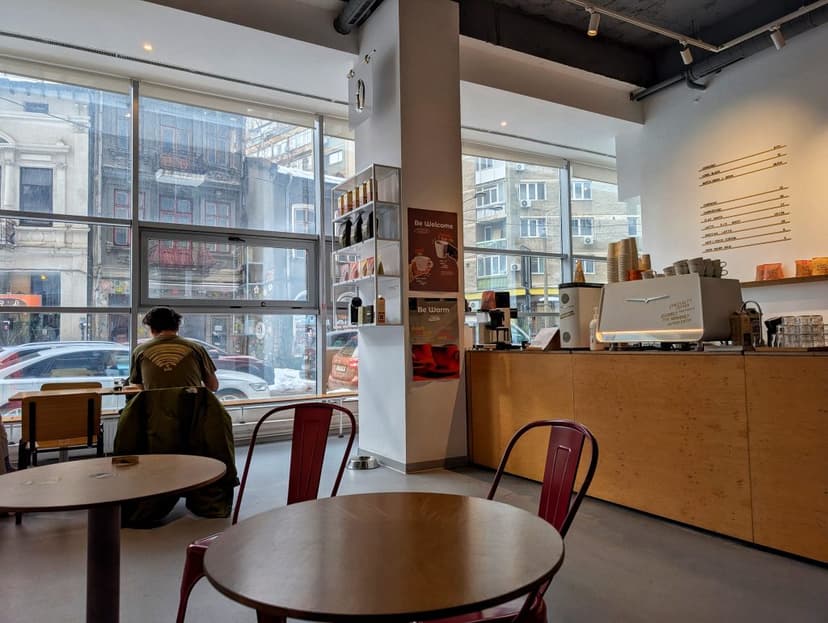
What people need depends partly on what the office used to give them, and what they can find instead depends on the places available beyond their homes. Working from cafés can become expensive, and many spaces where people can comfortably spend several hours are organised around consumption. This is evident in the brothers’ food court and in a large bookshop-café where another person I interviewed regularly works. Their size and relatively relaxed expectations around consumption allow people to stay for long periods of time without the pressure to keep ordering. Spaces designed for shopping, eating or browsing books become informal workplaces, precisely because they allow people to spend time among strangers without demanding much from them. But the availability of such places is uneven, and the freedom to use them also depends on working conditions, mobility, income and care responsibilities.
Disentangling these experiences matters for how we understand the social consequences of remote work. Loneliness, isolation and social contact do not always move together. Treating every expression of isolation as evidence that people need to return to the office risks mistaking a particular workplace for the social experiences it once provided. It also overlooks how those experiences might be found elsewhere, and how unequally the possibilities of finding them are distributed across the city. Sociality is not only a matter of community, shared identities or close friendships. It can also be experienced through the ordinary presence of others, in the sounds, rhythms and activities of an inhabited place. From this perspective, feeling isolated may have less to do with the relationships someone lacks than with the spatial and social conditions of their everyday life.
All interviewees’ names are pseudonyms.
References
Blokland, T. (2003). Urban Bonds: Social Relationships in an Inner City Neighbourhood. Polity Press.
Blokland, T. (2017). Community as Urban Practice. Polity Press.
Liegl, M. (2014). Nomadicity and the care of place: On the aesthetic and affective organization of space in freelance creative work. Computer Supported Cooperative Work, 23(2), 163–183. https://doi.org/10.1007/s10606-014-9198-x

Radu Mareș (he/him) holds a BA (University of Bucharest) and an MSc (KU Leuven) in anthropology. During his studies, his research explored topics such as sensory labour in the coffee industry and socioecological transformations in a natural protected area in Romania. Within ReWorkChange, he will build on his broader interest in labour and the social and material transformations shaping everyday life, and is particularly excited to return to Romania to conduct fieldwork as part of a global comparative study.