
The Changing Praxis of Understanding and the Moral Economy of "Good Work"
On the fourth of April 2026, I went home to Rohtak for my father’s fifty-seventh birthday. It is a tier 3 city, almost 100 Kms from my neighbourhood in Gurugram. My brother and cousins had organised a party. Out of curiosity, I asked who had planned it. My cousin, who works remotely for a global IT firm, told me that his generative AI assistant had done most of it. He had asked what a fifty-seven-year-old man might like for his birthday, where we could celebrate in Rohtak, what kind of cake to order, and what gifts might work. He had even automated parts of the ordering process, choosing cash on delivery so that my father could return things if he did not like them.
When I asked why they had not simply discussed it among themselves, both my brothers answered almost together: “Who has the time?” One added: “If things can be optimised, why would we waste time for nothing?”
Usually, deciding what someone might like draws on an accumulated knowledge of that person, i.e., memories, conversations, habits, previous birthdays, small observations gathered through years of living together. Here, some of that work of knowing had been transferred elsewhere. The answer emerges entirely from the computational system capable of producing a plausible version of what a man of my father’s age might enjoy.
This small domestic encounter became the starting point for a paper I recently presented, in an earlier and still developing form, at **EASA 2026**. The paper asks a relatively simple question: what happens to the practice of understanding when large language models become ordinary tools of everyday work?
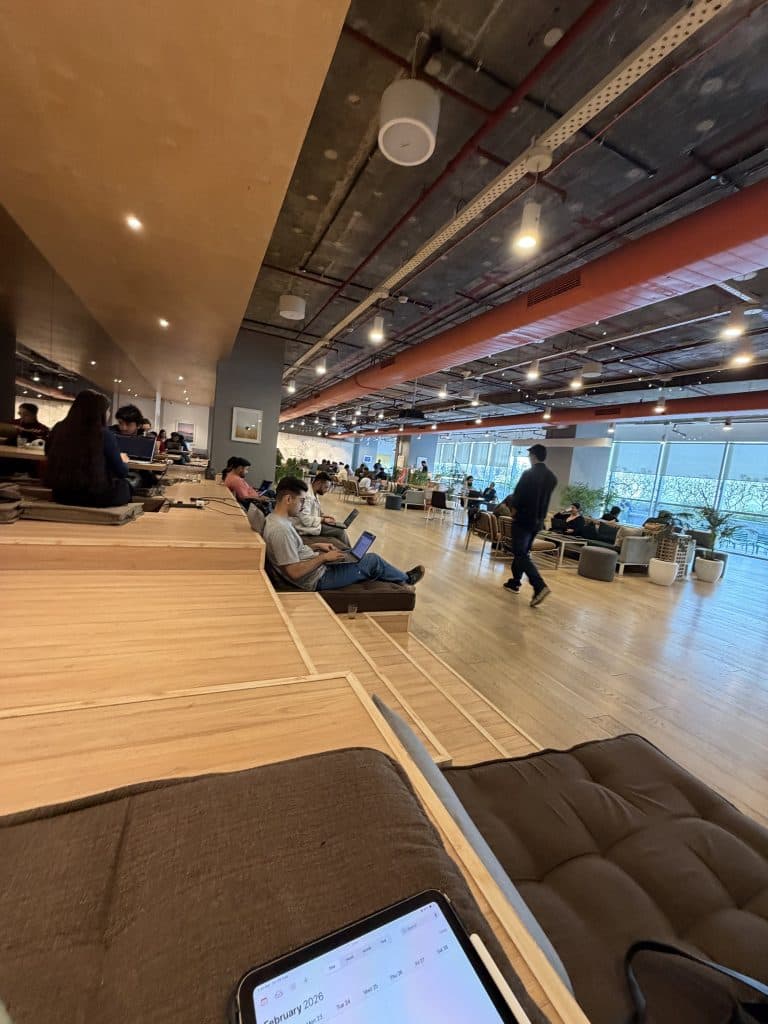
Over the past months, I have been conducting ethnographic fieldwork with remote and hybrid knowledge workers in Gurugram. Rather than asking only whether people “use AI,” I have been interested in what happens when they actually work through it. When they upload documents, or generate code, or compare products, or write marketing material, summarise reports, or ask their model(s) to explain something they previously would have worked out themselves.
One person I call Aritra works in marketing at a global Edtech firm. Part of his job involves competitor analysis and comparing product information. He showed me how he uses Notebook LM: he uploads product specifications and brochures and instructs the system to work only within those sources. Instead of reading two documents and constructing the comparison himself, he first defines the field within which the AI should operate. The system produces the comparison, and then he checks it.
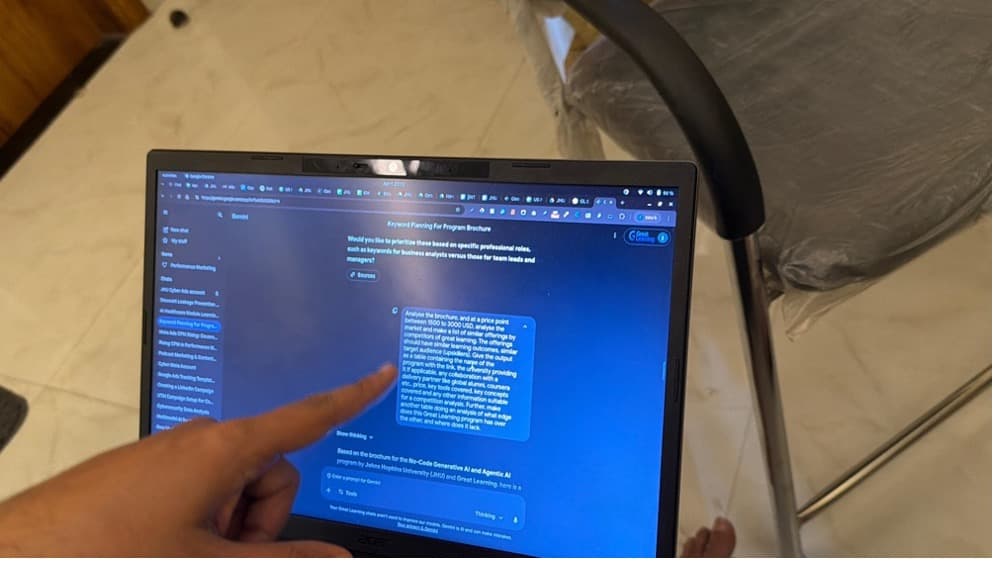
Importantly, he does not describe this as blind trust in AI. Verification is central to his workflow. He visits websites, downloads brochures, adds new sources and checks again. Where money is directly involved, for instance, decisions around advertising accounts, he becomes much more cautious.
So, what exactly has changed here? A techno-determinist account might say that the machine has replaced some part of Aritra’s knowledge. However, I argue that the organisation of knowing has changed. Understanding, as a practice, increasingly takes the form of bounding a field, generating something within it, and checking what comes back.
I saw another version of this with Ritik, a doctor by training who now runs an education consultancy. Ritik told me that he has almost no ability to write code himself. Yet, with Claude, he has built a CRM, document-management systems, marketing tools, webinar trackers and other parts of his company’s technical infrastructure.
When I asked whether he actually understood the systems he had built, he did not claim deep technical knowledge. Instead, he described understanding as something he was acquiring afterwards.
There is something strange about this sequence. We usually expect understanding to come before making, i.e., you first learn how something works, and then you make it. With Ritik, the order is almost reversed. The CRM exists before he fully understands its architecture. The website works before he knows all the reasons why. Understanding may come later, through maintaining the system, correcting it, or learning enough to speak to a developer about it. Production, in other words, can precede understanding.
Diya, another interlocutor, put this much more starkly. She uses AI throughout a pipeline for writing, coding, teaching materials and business development. “He does my job,” she told me of the model and “I am not learning anything.”
Yet Diya is far from passive. She studies the official prompting guidelines for different models, optimises prompts through other models, checks whether uploaded files have been completely read and even maintains her own external “memory” system to compensate for context-window limitations. What she has become highly skilled at is not necessarily producing each artefact herself but organising relations between systems so that the desired artefact appears.
Ritik and Diya made me return to a problem in pragmatic genealogy. Matthieu Queloz (2021) asks us to understand concepts through the practical needs they serve. Instead of searching for the timeless essence of something like “understanding,” we might ask what having such a concept allows people to do. But what if the need (to understand) itself changes with the technology?

The table above simplifies this shift. From my preliminary reflections on the interviews, reading, comparing, synthesising, and explaining increasingly move toward the model, while verification and judgement remain with the worker. For example, let's reflect upon verification. People checked their work output long before generative AI. Editors checked manuscripts, supervisors checked junior colleagues' work, auditors checked accounts. But in my observations, verification has taken a different place in remote workers' workflows. It is no longer necessarily something that comes after making. It can become the work itself. The machine produces the first object; the worker checks whether it can be trusted and so on. In this sense, AI does not simply meet an existing need for verification; rather, its outputs continuously produce things that now need verification.
This also changes what workers value in themselves and in others. As some forms of making move towards machines, workers increasingly describe competence through other terms: knowing which model to use, how to prompt it, how much context to provide, how quickly something can be produced, and whether one can recognise when the model has gone wrong.
One interlocutor summarised the shift neatly: employers increasingly care less about “how good you are in that particular task” than about “how good you are at the use of AI in a particular task.”
Moreover, Workers do not speak about this only as a technical change. They also speak about it morally. Time spent doing something that AI could have done begins to look wasteful. Knowing how to use the tool appears as competence, and refusing its use risks appearing outdated. Another interlocutor put the threat rather plainly: people who do not learn AI will become “obsolete.” A word usually reserved for machines and objects can now be applied rather easily to human workers.
This is where Chris Hann’s (2021) idea of the “chimaeras of freedom” becomes useful to me. Hann writes about labour regimes that promise autonomy and self-realisation while simultaneously producing new forms of dependence. Something similar is visible in the promise surrounding LLMs. Let the machine do the “donkey work” so that the human can supposedly move towards judgement, strategy and creativity. But these supposedly higher capacities are also being reorganised. Judgement can become selecting between generated possibilities. Creativity can become knowing how to prompt. And taking the time to understand something slowly can begin to appear as an inefficient practice.
As an anthropologist, I am therefore interested in a somewhat different question from whether AI makes workers more productive, or whether machines genuinely “understand.” I want to know what kinds of people, practices and values emerge when understanding itself begins to run through machines.
The research is still developing. But the birthday that began this inquiry keeps returning to me. Perhaps something similar is happening at work. The output may still be “good”, and the task may still be completed. But if understanding once helped define what it meant to be competent, autonomous and proud of one’s work, we need to ask what happens when producing the answer and understanding how one arrived at it no longer necessarily happen in the same place or (maybe) even (worse) in the same order?
Hann, C. (Ed.). 2021. Work, Society, and the Ethical Self: Chimaera of Freedom in the Neoliberal Era. Berghahn Books.
Queloz, M. 2021. The Practical Origins of Ideas: Genealogy as Conceptual Reverse-Engineering. Oxford University Press.
Hitesh (they/them/he/him) completed their MSc in Social and Cultural Anthropology from KU Leuven, Belgium and NTNU, Norway. Their anthropological interest lies at the intersection of science, technology, and socio-politics, with a particular focus on epistemologies and ontologies of [the] digital, exploring how humans engage with and are shaped by technological systems. They have conducted ethnographic research in India and EUrope. They will conduct their fieldwork in Delhi NCR/Gurugram. In their free time, they try to write poetry, do sports, and organise anti-colonial and anti-racist projects. You can learn more about their work at Post-Anthro-Apologist.