

Two Cups of Tea and Some Gossip: What Remote Workers Miss Out On
For a year, Barış, an administrative assistant at a logistics company in Istanbul, had experienced what remote work promises. No colleague at his desk, no gossip by the coffee machine. Just him and the work.
During the pandemic, when he worked in logistics, his office was his ten-square-metre bedroom in his family’s flat in Esenyurt, Istanbul. As soon as he opened his eyes, the computer was in front of him. He got up, made tea, and sat down on the screen. He did not even have breakfast.
There was nobody to drink that tea with.
Now he works hybrid. I met him during his lunch break on an office day, and the first thing he talked about was not the work but the break: coffee, cigarettes, gossip and jokes with his colleagues. “Unfortunately, you lose that,” he said about working from home.
He did not only mean the fun. “Actually, I think gossip is very useful in companies,” he told me. In the office, if a colleague looks upset, you ask why. They occasionally learn that a more recent hire with a lighter workload earns a higher salary. When you are working from home, you can only tell this to your partner, who does not even know these people. Fair enough.
At home, colleagues become “an image and a sound”, as Barış put it. Even with the camera on, a person is a small dot on a big screen. This has its advantages, too. Once, when a manager shouted in an online meeting, Barış turned the volume down from one hundred to twenty and put his feet up. A manager is much easier to bear at volume twenty.
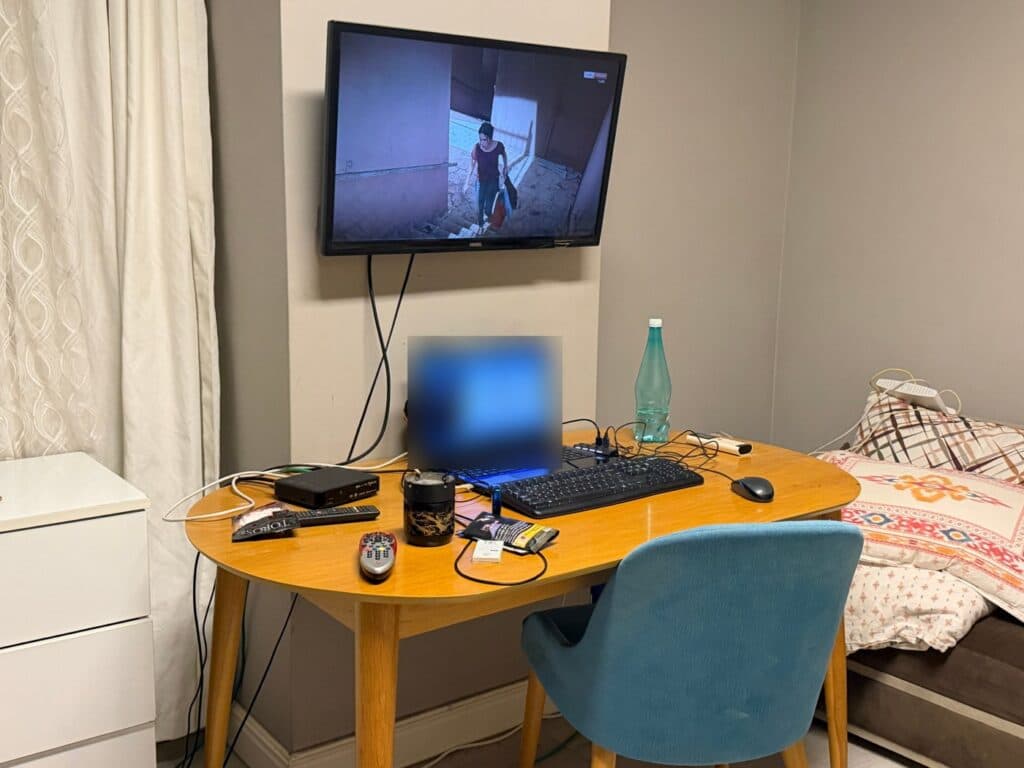
But it works the other way too. Nobody saw him either. When he was given the workload of three people, nobody noticed. You keep doing the work of three people, he said, until you quit or get fired. At home, there was no colleague to make him realize that he was covering the workload of three people.
And the requests kept coming. In the office, he said, when someone comes to your desk, you can say you are busy. At home, you open one email, and five, six, seven or eight more line up. Each one brings another request. Nobody sees the entire pile.
Can, a software developer, told me a similar story but in reverse. He is more productive at home but companies pay more to people who come to the office because managers can see them working. As he sees it, the bulk of the work gets done easily at home, but the extra pay goes to being seen in the office. Still, he first went to the office to get to know his colleagues. There, someone can explain a complicated task to you in thirty seconds. Now that he knows his colleagues well, he would like to work fully remotely. While Barış goes back to the office for his colleagues, Can wants to go fully remote now that he knows his.
So where does the conversation happen when working remotely?
Gül found the talk on Teams. For four years she has worked from home for a call centre selling insurance. In their breaks, she and her colleagues called each other on Teams. They complained about the customer lists:. Why is this data structured like this? Why does a customer who has already called rings again ten minutes later, swearing? Nobody else would understand why this mattered, only someone who had heard the same swearing that morning. And they asked each other the same small talk questions I hear everywhere in Istanbul: How many children do you have? Where are you from? These were women who had never met in person, sitting in their own homes, learning about each other’s lives one break at a time. The office coffee break did not disappear but moved into a video calls.
Some managers try to build this social space themselves. Selim, a project manager, adds every new employee to a WhatsApp group, so that they can talk outside Teams and emails. He tries to become friends with each of them despite relationships being exclusively virtual. Partly, he wants them to tell him when they need to leave early rather than simply disappear. Online friendship is also a management tool.
Others go back to the office to find it. Barış, on his office days, uses the time his AI tools save him to drink tea and gossip with his friends in the office next door. Getting there means sitting in traffic, and he puts up with it: “Believe me, the social interactions are worth the suffering in traffic.”
As the Turkish saying goes: "Two cups of tea, two pieces of gossip" (iki çay, iki dedikodu). I said these words myself, during an interview, when we were talking about what women who work from home miss. It sounds like a small thing. Over tea, people vent and share common work-related struggles, learn who earns more or carries the bigger workload, or who is going through a rough patch in their private lives and needs more support.
What happens to those who work alone at home, with nobody to drink tea with?

Elif Hazal Gougler (she/her) is an anthropologist and project manager from Istanbul. She studied Management of Performing Arts at Istanbul Bilgi University and later completed a joint MA program in Social Anthropology at the University of Bern and the University of Vienna. With professional experience in documentary production for international media networks and in EU research coordination at Kadıköy Municipality, her work explores mass communication and digital media, focusing on how media are created and adapted for specific communities, particularly women. In the ReWorkChange project, Elif Hazal will carry out ethnographic research in Istanbul, Türkiye.