
Adapting to the New Working Conditions: A More Positive Outlook on Remote Work Arrangements.
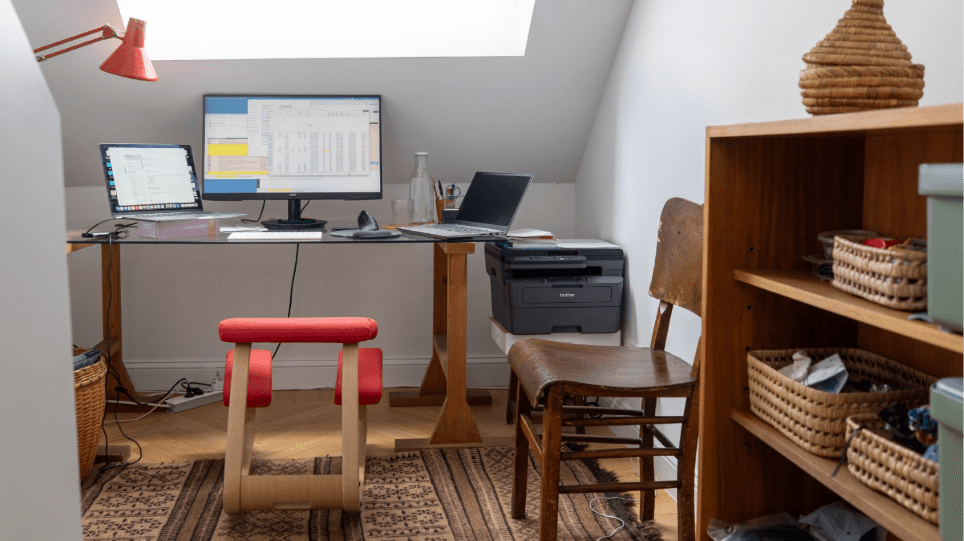
As part of new regimes of work, that is hybrid and remote work, the boundaries between working time and private life are often seen as either collapsing or blending. The constant presence of work and the sense of “being always available” that comes with access to work emails on personal mobile phones, can be alarming, as it becomes increasingly difficult to detach from work-related productivity.
In my previous blog post, based on initial fieldwork observations in Brussels, I described how time gained from the absence of commuting is frequently used in productive ways - a reminiscence of the COVID-19 pandemic mindset and the social pressure to use time at home “well”, that is, to always be “doing something”. My early observations were rather negative: people hardly ever had time to meet for an interview, as alongside full-time work, they pursued side projects, resulting in long working days and frequently working weekends.
As my fieldwork progressed, however, I began to hear more stories of people organising their remote working days according to their own rhythms and preferences. Interestingly, the vast majority of those interviewed do not like the idea of coming back to the office on a full-time basis. Instead, through trial and error, they develop creative ways to shape their working environments to suit their personal needs, establishing routines that showcase both adaptability and resilience in the face of potential work overload.
Samia, who works for the European Commission, is required to work in the office at least two days a week. She values the possibility to work remotely, particularly in relation to her neurodivergence:
“The fact that I can work remotely [...] suits me better, given the sort of person I am and how I function. For example, in the morning I need to have a coffee and get things done at my own pace, without being surrounded by people or having all that noise. [...] we’re now working in open-plan offices where we can’t control the lighting; we can’t switch it off and it’s on all the time – it’s white and very harsh, so it bothers me. It’s very noisy, [...] so we all need to have noise-cancelling headphones [...] because if someone’s having a conversation and you’re trying to concentrate and you have to write a briefing that was due an hour ago, but people keep coming up to you, or someone’s constantly talking... I just can’t get any work done.”
For Samia, the ability to control the working setting (the light, the noise level, the pace) seems to be of utmost importance, and if rightly adjusted, allows her to work in a comfortable (and productive) manner. The freedom that comes with working remotely, even if negotiated, once tasted, does not want to be returned.
“For me, the fact that I can get up and go into the garden, or go for a walk, that I can stroke the cat, that I can have a little nap during the day. That’s… That really saves me. I can’t imagine going back to work now and sitting in front of a computer for eight hours.”
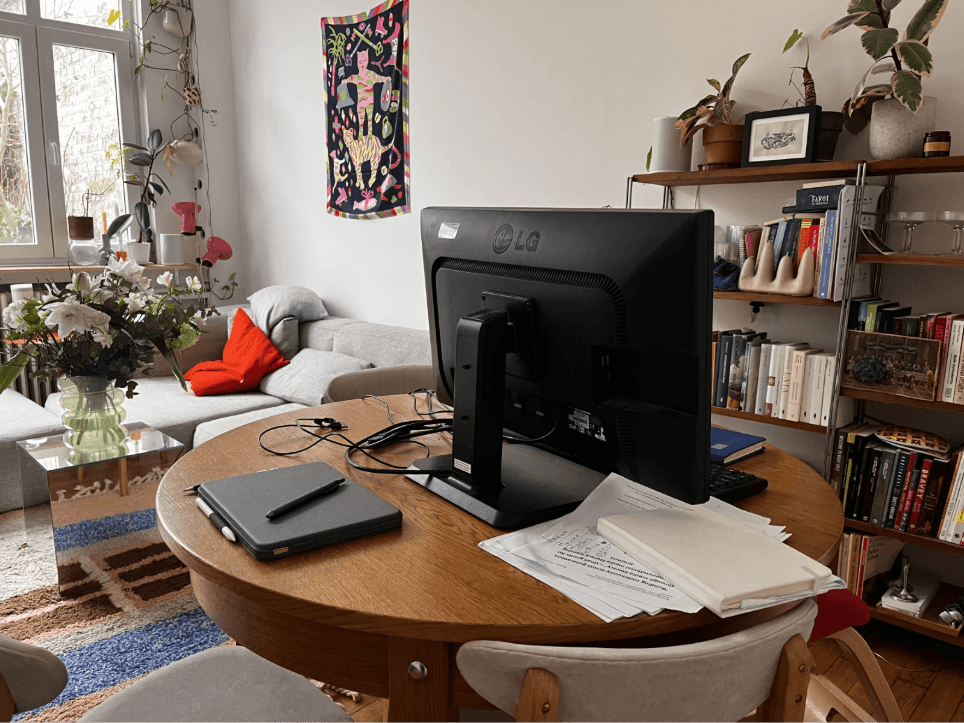
Through remote work, people seem to gain a greater awareness of work-life balance and how to maintain it. Depending on how long you have worked in hybrid or remote settings, you may have found your own ways of sustaining that balance. Like, for example, Ramona who has always worked in hybrid or remote roles. She has travelled extensively for work and has now (at least for the time being) settled in Brussels with her partner and two teenage children. Her current work is fully remote; she never goes to an office and never works outside her home, except when her family spends time at their second home on the Italian coast. She has established her routine over the years; she likes to work in her usual, comfortable clothes, sitting on her comfortable, ergonomic chair, when children are at school and the house is quiet.
These accounts reflect the experiences of relatively well-paid workers whose workloads may at times be highly demanding, yet who find ways to negotiate work-life balance because they have learned (sometimes the hard way), the importance of it.
While, for some, hybrid and remote work arrangements remain relatively new and different from traditional workplace culture, many have found ways to adapt. In doing so, they showcase what may be one of humanity’s greatest strengths - adaptability, informed by an understanding of what works, and what does not, on a personal level.
Aleksandra (Ola) Gracjasz (she/her) holds a PhD in Cultural Anthropology from Leiden University and Master's in Cultural Anthropology from Utrecht University. Her PhD formed part of the ERC-funded Food Citizens? project led by Prof. dr. Cristina Grasseni, in which Ola has carried out fieldwork in Gdańsk, Poland, looking at contemporary forms of citizenship enacted and manifested through involvement in a food-related network. Through her doctoral and master's research she has integrated photographic practices and theories. In the ReWorkChange project, Ola will carry out ethnographic research in Brussels, Belgium.