
“Do You Want to Be My Girlfriend?” Bypassing the Capitalist Dichotomy of Production and Reproduction in the Study of Coworking Spaces in Mexico City
One of the central concerns in the study of remote work has been whether working from home collapses the boundaries between work and leisure, private and public life, and production and reproduction, as well as the social consequences that this may entail. A hypothesis that has become particularly influential among scholars in Mexico, as elsewhere, is that when homes become offices or spaces of production, the spatial, symbolic, and affective boundaries that once separated intimate and working life are blurred, transforming the domestic and intimate sphere into a site of capitalist exploitation. However, this argument often assumes that these spheres have always been distinct prior to the pandemic, overlooking the cultural, historical and social dynamics- both before and after COVID-19- that become salient through long-term ethnographic fieldwork and cross-cultural comparative research.
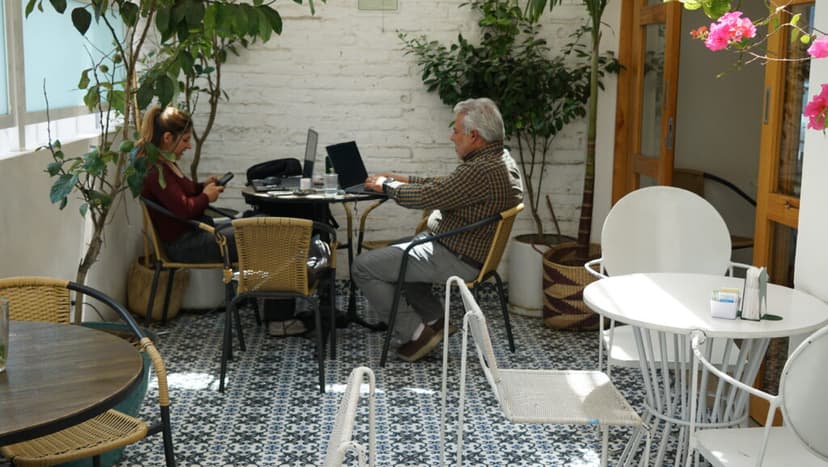
Moreover, what happens when work is relocated not to the home but to third spaces such as coworking spaces or cafés, where people increasingly spend a substantial portion of both their working time and their everyday lives?
Theoretically, under capitalist ethics, the sphere of work is conceived as separate from the sphere of personal and family life in the production of neoliberal subjects: workers who are expected to be more focused on their tasks, and therefore more productive, when detached from emotions, family life, and other affective relationships. This logic is reflected in the compartmentalisation and physical separation of spaces associated with work (production) from those associated with social reproduction. At the same time, capitalist modes of production continuously salvage and commodify social relations, practices, and forms of life that were not previously conceived as economic, transforming them into new sites of value production and capital accumulation.
The capitalist work ethic, for example, contrasts with that of state socialism, which I examined during my doctoral research. Under state socialism, productivity was understood as a collective endeavour and, in Leninist terms, it was ideologically assumed that a stronger emotional attachment to the workplace would foster greater responsibility. In practice, workers frequently volunteered to work overtime to help their brigade meet production targets. Indeed, they also worked to the point of exhaustion, but this was experienced as part of a shared collective goal rather than as exploitation. State socialist enterprises also provided kindergartens, schools, and other social services, while workers and their families commonly spent weekends socialising together. Work was therefore not conceived as separate from social and affective life but was instead deeply embedded within it.
Different modes of organising production, work, and social life coexist alongside new forms emerging through the ever-growing digitalisation of labour and the widespread adoption of hybrid employment. Coworking spaces in Mexico City have become particularly revealing sites for observing the evolving relationship between production and reproduction, raising the question of whether these two spheres have ever truly been separated, at least in the Mexican context.
“Do you want to be my girlfriend?” is written on the wall of a room on the upper floor of a coworking space in the neighbourhood of Coyoacán. The room is covered with plastic rose petals and decorated with red, kitsch ornaments. A television screen, a small table, and a sofa complete the setting for the private ritual of asking someone to officially become one's girlfriend—a well-known social practice in Mexico. The room can be reserved for as many hours as needed, and the staff will provide food, drinks, and whatever else the couple may request.

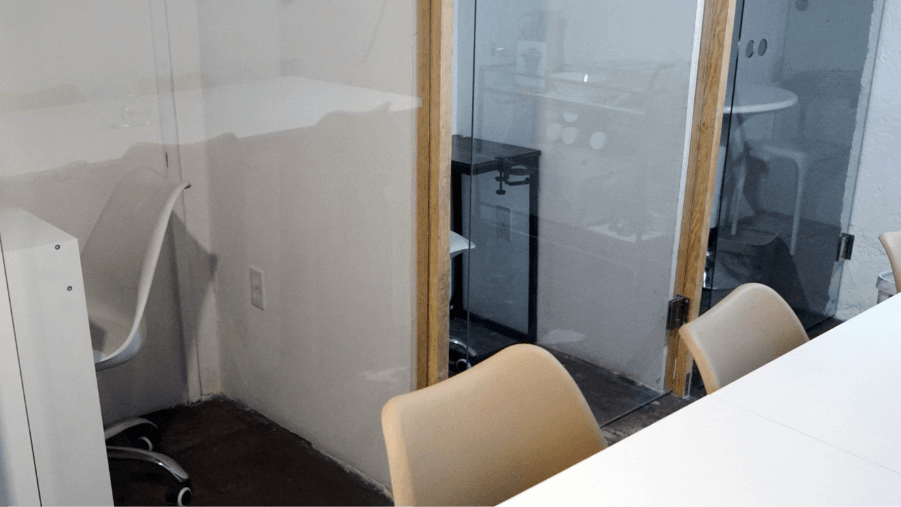
As one of the newest coworking spaces in the area, it seeks to maximise both the use and profitability of its premises by combining shared workspaces with a flower shop, a café that hosts workshops, and an upstairs area of private rooms that can be reserved either for work meetings or for intimate occasions. This way, while someone may be conducting a business call with clients in the adjoining room, separated only by a thin glass partition, another person may be declaring their love, celebrating a wedding anniversary, or sharing an intimate family moment.
Rather than reinforcing a strict division between work and private life, these new spaces of work reveal how production and social reproduction are increasingly folded into one another. Their coexistence is not merely a consequence of digital technologies or the post-pandemic reorganisation of work. Although it reflects a broader economic transformation through which coworking spaces seek to monetise an ever-expanding range of human activities, it also responds to people's enduring needs for intimacy, companionship, celebration, and belonging.
Ethnographic fieldwork reveals these tensions in ways that abstract debates about work–life boundaries often cannot. It demonstrates that the relationship between production and social reproduction is neither one of complete separation nor total collapse, but rather one of continual negotiation, in which economic imperatives and human relationships constantly shape and reshape one another.

Iris Pakulla (she/her) is an anthropologist and filmmaker of Spanish, French, German and Polish heritage. She studied social anthropology in the UK and media communication studies and documentary cinema in Spain and France, respectively. She has over 10 years' professional experience in the documentary film sector. Her new research is taking place in Mexico as part of the ERC project, ReWorkChange. During her PhD at the University of Cambridge, which involved fieldwork in Mongolia, she focused on topics such as extractivism, the anthropology of labour, digital political activism, everyday politics, and female reproductive health.