
From an Anthropology of Remote Work to an Anthropology of Leisure
I am just back from holidays. Breaks from work are very useful because they allow preliminary insights and ideas to be digested and seen from a different perspective and with different eyes. In the previous six months of fieldwork, I carried out around 70 interviews and many more conversations on remote work and the consequences it has on people’s lives. I have not analysed in-depth these interviews yet, but what started resonating with me while I was walking by the sea on a little Greek island was that all the ethnographic data collected so far speak to a theory that I have engaged with in my previous work on digital media and technology. This is Daniel Miller and Jolynna Sinanan’s theory of attainment (2014).
The most common element among all the research participants in my fieldwork so far has been that remote work has liberated time in a context where this is always lacking. This was one of the most significant consequences of remote work across different generations, family compositions, genders, and social classes. For example, Luca, a 33-year-old guy who had to commute 2.5 hours every day for work, had to leave home at 7.45 and be back at 7.15. Because of hybrid remote work, he can now start working at 9 and end at 6 three days a week. He can also use the 1-hour-long lunch break to do what he wants. (In Milan, the standard working day is longer than in most countries in Central, Western, or Northern Europe. It is made up of 8 hours of work, plus a mandatory one-hour lunch break. Thus, the standard working day becomes 9–6 and not 9–5.) Every week, Luca now has more than 10 extra hours available to engage in extra work activities.
In Milan, remote work has freed time, mostly by eliminating commuting, but also by making employees more efficient and enabling them to complete their tasks in less time, by using the short breaks during the working day to do laundry, cleaning, or grocery shopping that were previously done during the weekend, by using the lunch break to do some chosen activities instead of spending time with “boring” colleagues, or sometimes by simply working less. In a city where everyone struggles with the lack of time, working days are long, and social and cultural events are many, remote work is creating new opportunities to do what people choose to do. These activities could include spending more time with their children, taking care of older parents, participating in grassroots associations and political activities, seeing friends, drinking more alcohol, singing in a choir, doing more sports, going to the cinema, becoming an Instagram influencer, sitting at home and doing nothing, or also living a polyamorous life in co-working spaces. These are only a few of the activities enabled by remote work in Milan. Remote work has enabled what people were previously unable to do because it gives them time, one of the main deprivations in Milan, like many other urban contexts around the world.
The theory of attainment accounts for “how technology becomes an ordinary aspect of being routinely human” (p. 13). Miller and Sinanan argued that people who have access to a new technology use it to facilitate things they were previously unable to do because of a lack of means. This theory stresses that new technologies first facilitate latent capacities and aspirations, and they then become the new taken-for-granted conditions of who we are. In the context of my research, liberated time has enabled the realisation of previously frustrated aspirations and desires. These new activities have then become taken for granted. I was asked several times by my research participants, “How could I survive before remote work?”, “How could I manage work-life balance before Covid-19 and remote work?” In a few years, new routines that incorporate new activities outside work have become “normal”. Thus, the theory of attainment offers a lens for understanding how remote work brings both continuities and changes. It also allows me to view new leisure practices as expressions of human beings’ values and aspirations. While technologies do have affordances with agentic power that shape and largely influence mediated practices (Costa 2018), free time works differently: it creates the conditions within which people can fulfil some of their aspirations. Thus, observing what people do in their liberated time is a wonderful way to understand what matters to them, what their desires and moral values are. My first impression is that research participants in Milan tend to invest their newly freed time in social relationships and social activities. Sociability is what matters the most to them. Is this also the case in Amsterdam, Shanghai, and all the other field-sites?
References
Miller Daniel and Jolynna Sinanan. (2014). Webcam. Cambridge: Polity.
Costa Elisabetta. (2018). Affordances-in-practice: An ethnographic critique of social media logic and context collapse. New Media & Society. 20 (10): 3641-3656.
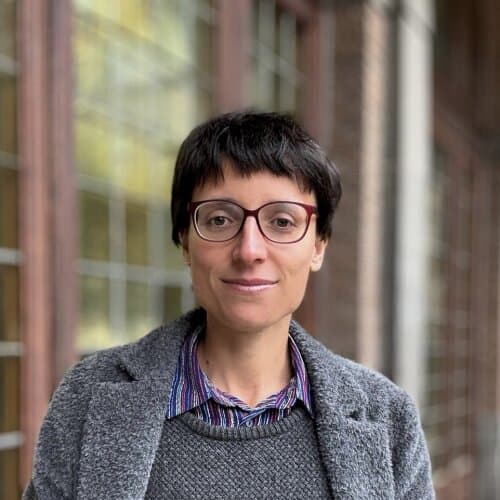
Elisabetta Costa (she/her) is a digital anthropologist. Her research focuses on how people’s everyday uses of media technologies change relationships, gender, politics, work, and mobility. She has conducted extensive fieldwork in Lebanon, southeast Turkey, and Italy. Her books include Social Media in Southeast Turkey (2016, UCL Press), How the World Changed Social Media (with Miller D. et al., 2016, UCL Press), and the Routledge Companion to Media Anthropology (co-edited with Lange P. G, Haynes N., and Sinanan J., 2022, Routledge).