
Notes On Neighbourhoods in Amsterdam
To get a deeper understanding of how remote work is experienced in everyday environments, I have been diving into the history of my Amsterdam field site, a municipal district named ‘Oud-West/De Baarsjes’. As the name shows, it essentially combines two neighbourhoods. This is a relatively new organisational structure put in place a few years ago and part of a longer series of municipal experiments on how to divide Amsterdam’s many buurten (small areas of often just a few streets), wijken (larger areas, more like a neighbourhood, such as Oud-West and De Baarsjes), and stadsdelen (large parts of the city, such as the whole ‘West’) in the administration. The result is an interesting combination of two different spaces on either side of a long and straight canal, the Kostverlorenvaart.
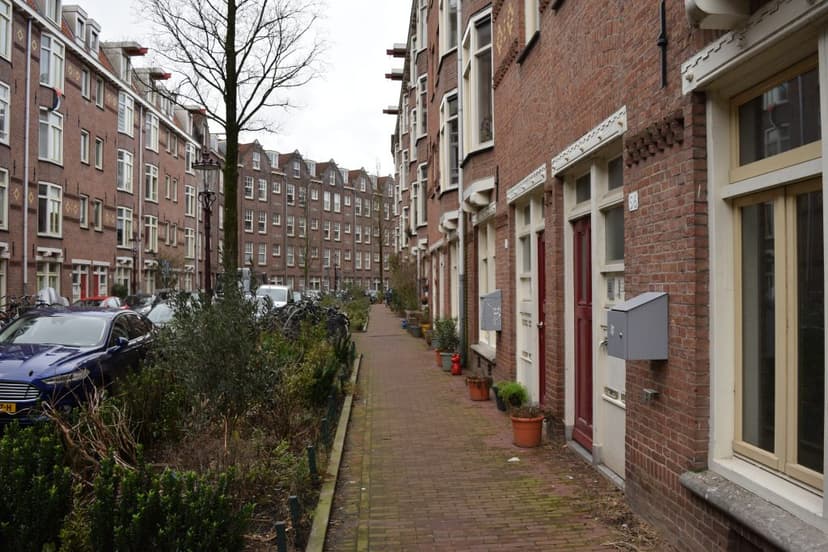
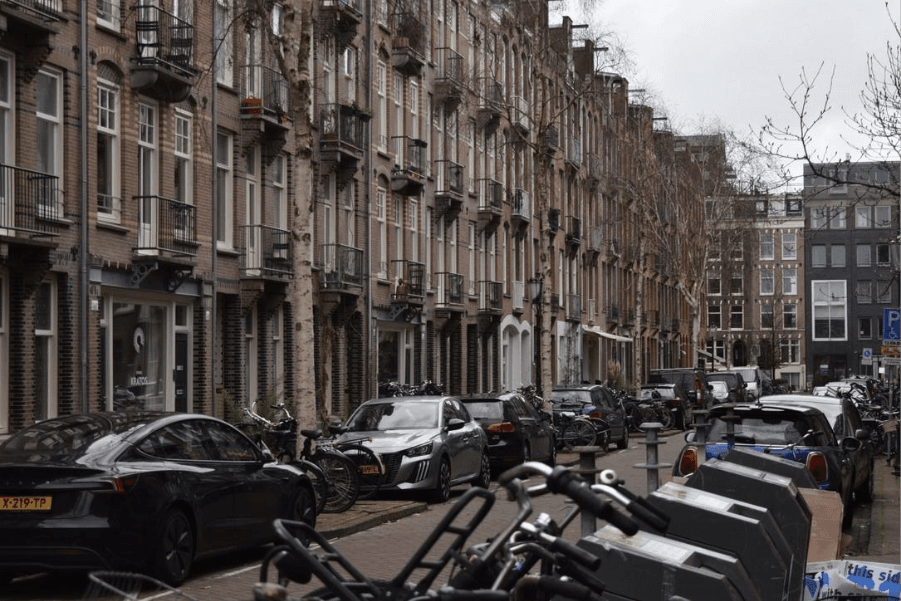
I first started going on regular walks, often from Oud-West, which is closer to the centre of Amsterdam, to De Baarsjes, further out. Almost immediately, I noticed that there was something strange about the shift in architecture. As soon as you cross the canal, the shapes, colours, and overall spatial layout change quite noticeably. I couldn’t really articulate why until I started reading old library books on the history of both neighbourhoods, and scrutinising the surroundings on my walks. In Oud-West, there are many long continuous rows of brick apartment blocks up to four or five floors (usually without elevators), the kind often associated with the image of Amsterdam. I read that most of these buildings were constructed in the late nineteenth and early twentieth century, during a period of rapid expansion. Many were realised quickly and relatively cheaply, which later led to extensive renovations and sometimes complete replacement. The result is a neighbourhood that can feel somewhat patched together.
Paying attention to the buildings that do not fit this older street makes this sense clearer. Scattered among the nineteenth-century blocks are smaller apartment buildings that appear more recent. They are often lower, with three or four floors, and have flatter façades with little ornamentation. There may be slightly more street space, small areas of greenery, or entrances to houses that are less directly connected to the pavement.
Crossing the Kostverlorenvaart into De Baarsjes, the built environment appears remarkably less patched, and many of the buildings seemed to belong to a coherent plan. I found out quickly that a large part of this can be linked to the ‘Amsterdam School’ movement. Corners are emphasised, façades curve slightly, and entire blocks appear to be designed together.
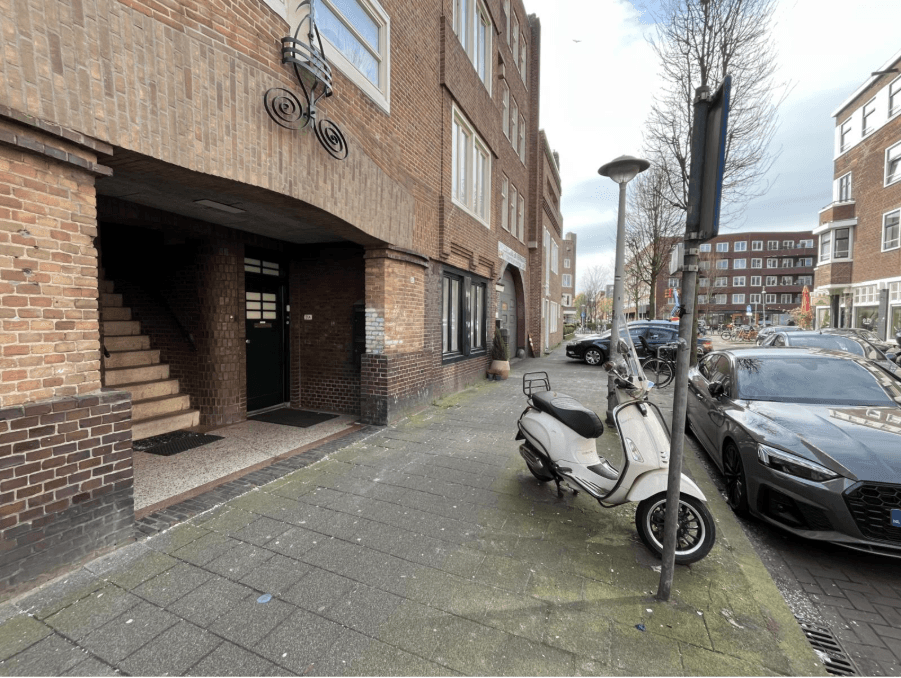
From what I have read so far, the Amsterdam School was not only an architectural style but also a broader approach to urban design. It brought together architecture, craftsmanship, and social ideas, with the aim of creating a coherent living environment that was functional but also beautiful. Buildings, street layouts, and spatial details were considered in relation to each other, sometimes described as a ‘total work of art’ or Gesamtkunstwerk. Walking through De Baarsjes, these ideas become visible in relatively small details. Brick is used in a more expressive way, with variations in colours and patterns. Entrances are more clearly marked, and corners often shape how streets open or change direction. The architecture actively organises the space rather than filling it.
Moving between the two areas, the canal begins to feel less like a boundary and more like a transition between different ways of organising the city. On one side, there is a dense and somewhat irregular accumulation of building periods. On the other hand, a more planned environment is shaped by a clearer set of ideas. I wonder if this loose distinction is consistent enough to shape how the area is experienced in the context of remote work, when people spend more time at home and in the neighbourhood.
Sources
Heijdra, Ton. 2022. De victorie begint in Oud-West. Amphora Books, Stadsboekwinkel: Amsterdam.
Museum Het Schip. “Amsterdamse School.” Accessed April 12, 2026. https://www.hetschip.nl/amsterdamse-school
Tabak, Cecilia. 2010. De Metamorfose van De Baarsjes. Uitgeverij Bas: Lubberhuizen.
Fiona Holdinga (she/her) completed a bachelor’s and master’s degree in cultural anthropology at Utrecht University. Her research interests include the anthropology of morality and ethics, the nature/culture debate, the multispecies turn, and visual and sensory approaches. For the ReWorkChange project, she will conduct research in the Netherlands.