
Notes on Understanding Violence and Its Ruptures in the Everyday Lives of Remote Workers in Mexico City
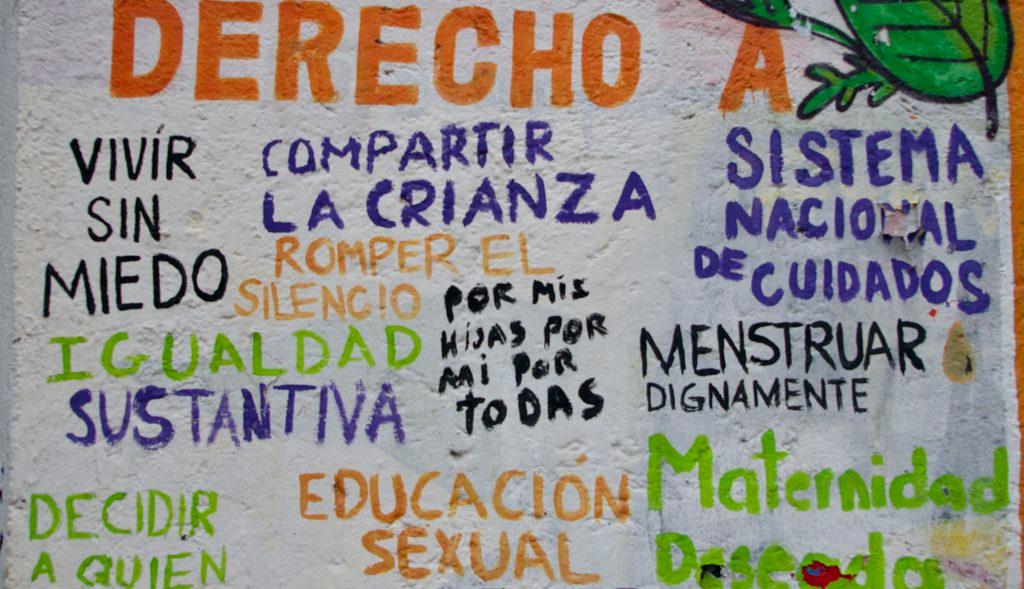
Talking with my interlocutors about wellbeing and mental health in Mexico has been the most difficult part of my research so far. Conversations, especially with women, often began with a casual chat about the importance of keeping up healthy daily routines before turning to accounts of domestic violence, sexual abuse and child abuse in some of their most harrowing forms. For ethical reasons and to protect my interlocutors, I had no intention of asking them directly about violence and never did. Even so, it surfaced unexpectedly in our conversations. Sometimes someone would break into tears, and the interview would give way to a moment in which listening and offering comfort took precedence. These sudden outpourings of pain and despair came from people of different ages and social classes, and I could rarely anticipate when they would arise. They happened while video whatsapping or while visiting the homes of my interlocutors. Their recurrence led me to think of violence in Mexico as an omnipresent force, an ever-expanding ill whose presence could be felt in every corner and inch of social life, even in conversations about apparently seemingly lighter topics such as teletrabajo (remote work).
Violence has a long history in Mexico. Let me give a few figures to convey its scale. Between January and September 2026 alone, Mexican authorities recorded 13,374 victims of intentional homicide and femicide and 65,687 victims of offences against sexual freedom and security (see note 1). Over those same nine months, REDIM reported that 26,026 children and adolescents under 18 were recorded as victims of family violence and 25,899 as victims of sexual offences (see note 2). During my fieldwork, I unexpectedly found myself amid this violence, listening as my interlocutors described how it had entered their lives. I was aware of the limits of what I could offer as a researcher without training in psychological care or legal counselling. In those moments, I would stop the recording. Sometimes we hugged, took a break, had tea, or went for a walk. Afterwards, I would turn to lighter topics. After all, life went on. The next Zoom meeting was already scheduled, WhatsApp messages from clients kept coming in, and there were children to pick up from nursery.
In the days following an interview, I would check in with my interlocutor to see how they were feeling and sometimes ask whether they wanted to speak with a psychologist. If they did, I would help them find one. I also offered to help Andrea, a GP I was interviewing for my research, find a safe place to play for her seven-year-old daughter, Laurita. Laurita had suffered abuse two years earlier and was in a very fragile psychological state. I suggested that a family I am friends with get in touch with Andrea. They invited Laurita over to play with their daughter, who was the same age. Most of the time, though, all I could do was listen.
I chose to leave the details of these accounts out of my writing. I worried that recounting these details could put my interlocutors and me at risk and might reproduce, in the telling, some of the violence they had experienced. I also wondered how to write about violence without letting it dominate the account, a question I have been thinking through in light of Sherry Ortner’s (2016) concerns about the making of ‘dark anthropology’. I could focus instead on how a family in the neighbourhood gave Laurita a safe place to play. That gesture of care was real and very common in my fieldwork and deserves a place in the account. Yet if I wrote only about that gesture of care, the violence and terror that made a safe place necessary would go unaddressed, and my interlocutors’ stories would once again be swallowed by ordinary life.
How, then, might I theorise violence within a study of social change and remote work in Mexico City?
Two dynamics come to mind as ways of thinking through this question. The first is continuity. Sara Ahmed’s notion of ‘stickiness’ helps me think about how the affective force of past encounters can carry into the present (2004). Continuity also offers an anthropological lens through which to consider what people seek to keep intact in their everyday lives and the labour they put into doing so (Heywood and Yarrow, 2026). The second is rupture. Violence and terror repeatedly disrupt the everyday work of sustaining continuity. As Andrew Strathern and Pamela J. Stewart (2006:7) explain, terror “proceeds from specific acts that rupture normative expectations. Terror consists precisely in intrusions into expectations about security, making moot the mundane processes on which social life otherwise depends”.
Might social change under conditions of pervasive violence be understood as a movement between continuity and rupture, between the daily work of making a life and the moments in which it breaks open?
With this question in mind, I asked Sara, a real estate agent who had suffered sexual violence, what she would take with her into the future. “Freedom,” she answered. “To free myself of what holds me back.”
Disclaimer
All personal names in this post are pseudonyms.
Notes
References
Ahmed, S. 2004. The Cultural Politics of Emotion. Edinburgh: Edinburgh University Press.
Heywood, P., and T. Yarrow. 2026. “On the problem of continuity: a theory of culture beyond invention.” Journal of the Royal Anthropological Institute 32(2): 365–383.
Ortner, S. B. 2016. “Dark anthropology and its others: Theory since the eighties.” HAU: Journal of Ethnographic Theory 6(1): 47–73.
Strathern, A., and P. J. Stewart. 2006. “Introduction: Terror, the imagination, and cosmology.” In Terror and Violence: Imagination and the Unimaginable, edited by A. Strathern, P. J. Stewart, and N. L. Whitehead, 1–39. London and Ann Arbor, MI: Pluto Press.
Iris Pakulla (she/her) is an anthropologist and filmmaker of Spanish, French, German and Polish heritage. She studied social anthropology in the UK and media communication studies and documentary cinema in Spain and France, respectively. She has over 10 years' professional experience in the documentary film sector. Her new research is taking place in Mexico as part of the ERC project, ReWorkChange. During her PhD at the University of Cambridge, which involved fieldwork in Mongolia, she focused on topics such as extractivism, the anthropology of labour, digital political activism, everyday politics, and female reproductive health.