
The Absence of Remote Work in Corporate Co-Working Spaces
My first blog post focused on how people work from tiny apartments in Milan. This one turns to another important site of remote work: co-working spaces. Milan offers a large variety of co-working spaces, whose transformations and economic models have also been explored by scholars and national media. What struck me most during my fieldwork was the desolation and emptiness of co-working spaces owned by global corporations. With the diffusion and normalisation of hybrid work, many co-working spaces are now used by companies aiming to reduce rental costs. Companies often rent one or more rooms exclusively for their employees, with very little sharing of spaces between workers from different companies. Social and cultural events, as well as community-building activities, once defining features of co-working spaces, are now limited or entirely absent. Moreover, in these large business-oriented co-working spaces, the areas dedicated to individual remote workers or freelancers are almost completely unused.
Last week, I visited a co-working space owned by a large global chain. It was relatively new, having opened only a few years ago. The environment was immaculate: white walls, polished surfaces, and carefully designed interiors. Everything looked clean, organised, and untouched. I spoke with the receptionist, a kind and friendly woman who explained how the space was organised and how much it cost. As expected, most rooms were rented out to companies. One room, however, labelled “co-working,” was reserved for individual workers not necessarily affiliated with any company. I asked her: “How many desks in the co-working room are occupied today?” She replied that eight out of the nine desks were taken. I was surprised. In previous visits to similar co-working spaces, the rooms dedicated to individual users had often been completely empty. I did not expect to hear that this one was almost full. At the end of our conversation, the receptionist offered to show us around. The corridors were silent and uninhabited. We did not encounter a single person. The excessive cleanliness of the place gave me a strange sense of anxiety, as if the space had been designed purely for functionality rather than for human beings spending most of their waking lives there. Then she opened the door to the co-working room. It was empty. “Wasn’t it occupied by eight people?” I asked. “Yes, of course,” she replied. “I meant that eight desks are paid for.”
Last week, I visited two other co-working spaces owned by corporate chains and found similar situations. Companies rented offices there, but the areas intended for individual remote workers or freelancers remained deserted. One space had a few hundred square metres of stylish open-plan workspace directly facing the reception area, yet it was entirely unused. In another co-working space, the receptionist initially tried to hide the absence of users during our visit. Only after I repeated my question several times did she admit that only one man had used the room that day, and that by 4 p.m., he had already left.
Many remote workers I have met so far struggle with small apartments, isolation, and the loneliness of spending most of their lives working alone from home, and almost all of them mentioned that co-working spaces are simply too expensive for them. Monthly costs between 250 and 500 euros are simply too much. Other research participants said that commercial co-working spaces feel too similar to traditional offices, offering little or no opportunity for socialisation.
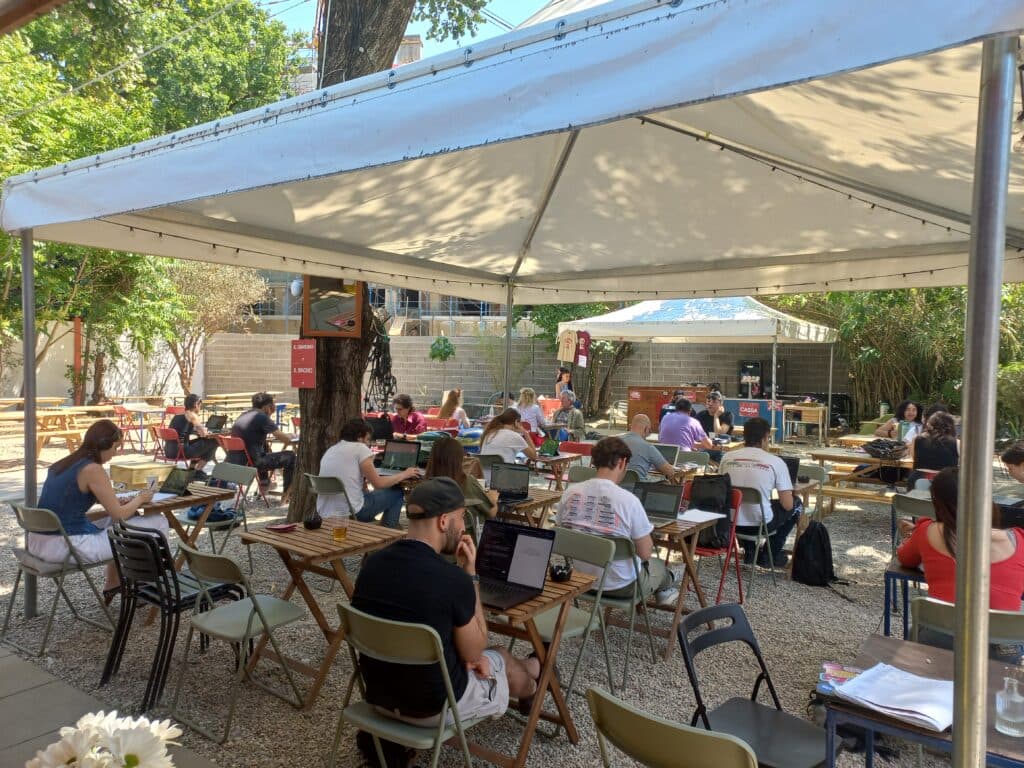
The situation is different in smaller, cheaper, hybrid, or community-based spaces, which appear to be far more successful. These co-working initiatives are often more affordable and seem much more capable of creating the forms of sociability that many remote workers are actually looking for. A few days ago, I presented my research project to a running group connected to a community space that also hosts informal co-working activities. Around sixty people attended. At the end of the presentation, one participant, a physicist who works mostly from home, jokingly responded: “Well, we don’t need anthropologists, we need psychiatrists!” He was referring to the condition of loneliness and isolation that he and many other workers must face every day. If this has to remain only a joke, Milan needs more affordable co-working spaces that can also provide opportunities for socialisation and the building of meaningful relationships.

Elisabetta Costa (she/her) is a digital anthropologist. Her research focuses on how people’s everyday uses of media technologies change relationships, gender, politics, work, and mobility. She has conducted extensive fieldwork in Lebanon, southeast Turkey, and Italy. Her books include Social Media in Southeast Turkey (2016, UCL Press), How the World Changed Social Media (with Miller D. et al., 2016, UCL Press), and the Routledge Companion to Media Anthropology (co-edited with Lange P. G, Haynes N., and Sinanan J., 2022, Routledge).