
Tidying in Amsterdam: Hybrid Spaces of Work and Life
Last week I visited the office of a small theatre organisation, located in a large school-like residential building with multiple other companies. The office comprised a single room on the ground floor, and I was greeted by three of the four employees who make up the team. After walking in, I first spotted the four white stand-up desks in front of me, clustered so they faced each other, right next to some large, tall windows overlooking the street outside. On the left, there was a little counter and sink with some teacups, a kettle and microwave, and a small fridge. But I couldn’t stop looking to my right, where there was a large red velvet curtain lightly obscured rows of children’s costumes. It was a rainbow of colours, textures, and materials poking out from the racks they were tightly packed on.
The small room felt cosy, perhaps akin to what I imagine a family home to be: organised, but with everyday items strewn around, from pictures to empty mugs and books, coats, beads, and a tote bag. A few plants dotted the room, along with a dusty little dark blue sofa by the door and small lamps that cast a warm glow on the grey October day. I settled at the empty desk in the little cluster with a cup of tea. The women working here introduced themselves as Mara, 43, a production coordinator; Sophie, 41, an education coordinator; and Eva, 39, the director of the organisation. They had kindly invited me over via a mutual friend to talk about this research project, since they all work hybrid. We started chatting about working in this office versus working from home, and their answers were quite different.
Mara enjoys both, but prefers staying home when there is no one in the office. At home, she works from her kitchen table and likes to spread her tasks throughout the day. If she has four hours of work to do, she explained, she likes to take ten hours for it, doing other things in between, such as making tea, doing the shopping, or seeing a friend. She has two teenage children, who she told me are very good at not disturbing her when she sits at the kitchen table and tells them she needs to focus.
Sophie, by contrast, greatly prefers working from the office because she finds it very hard to focus at home. She told me how she does not have enough space, how there are too many ‘things’, and how she struggles to keep everything organised. With two young children, she finds her house full of distractions. She notices the washing that needs to be put away, a picture frame on the floor, the children’s Duplo strewn around. “Eva always gets an urge to organise here,” she said, smiling at Eva, who nodded. “But I can completely let go. I think, yes, that closet [she points at a big grey metal cupboard next to the sink] needs to be organised. But then I think, yes, but I am at work here. So, then I can let it go. Not at home.”
Eva interjected, explaining that she herself has a “nice space” at home. She does not have children, manages to keep it organised and, if it is not, goes to sit in a different room. But she also relayed that the day before I came by, she had experienced an opruimwoede, a kind of cleaning rage, at the office. “Yes, I can ignore the mess at home, but for instance here… then I know I have to give in. Because if I don’t, then, well, this is also for a greater cause… So that is also nice. So, then I become calm because of that; yes, then I can focus better.” Eva shared this with a laugh. When I asked Mara about her home, she told us that she also keeps it tidy and organised and finds this quite important. She explicitly does not want to have to look for things, and jokes that her children are “drilled” by her in this way. Speaking more about tidying cluttered spaces, they arrived at a Dutch saying: “Ruimte in je huis, geeft ruimte in je hoofd,” meaning space in your house gives space in your head.
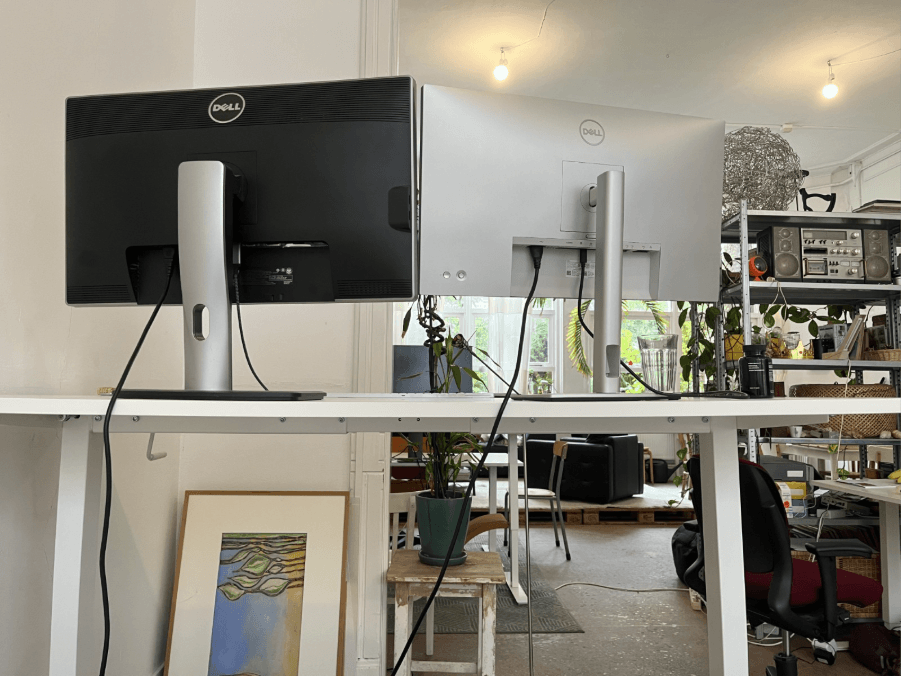
Image, taken by author, of another office with a similar homely feel.
Doing ethnographic research in a context that is very familiar to me, the Netherlands, I have only recently started noticing how ordinary hybrid working has become. Leaving the self-employed and freelancers aside for a moment, everyone I have spoken to so far either has an office they go to a few days a week or rents a desk in a co-working space. It makes me think about the messiness of apparently neatly bounded categories of work and non-work, paid and unpaid labour, and, consequently, home and office. Working from home does not mean that paid work simply enters a labour-free zone called “home” (Orman et al. 2023, 40).
The home is also a place where things must be continuously done, maintained, and organised. Speaking of hybrid work, then it seems analytically interesting to look through a lens of connection, instead of separation or boundary-making, as is often done when researching hybrid work. To start, the question here becomes: why do certain spaces allow these women to do certain tasks and ignore others? Why does a (homely) office need to be tidied by one person, and can it be comfortably left by another? In their recent article on decolonising work-family research, Farista and Jaga (2026) also argue that we should look beyond the question of how individuals manage the boundaries between work and family, and instead pay attention to the material and relational conditions through which these become or are in fact entangled. Space in the house gives space in the head, but what kinds of ‘work’, paid or unpaid, are required to make this space, and where is it located?
References
Farista, Feranaaz, and Ameeta Jaga. 2026. “Decolonising Work-family: Why Should We and Why Now?” Community Work & Family, October, 1–13. https://doi.org/10.1080/13668803.2026.2749798.
Orman, Emily, Pauline MGuirk, and Andrew Warren. 2023. “Emergent Time‐spaces of
Working From Home: Lessons From Pandemic Geographies.” Geographical Research 62 (1): 28–44. https://doi.org/10.1111/1745-5871.12602.
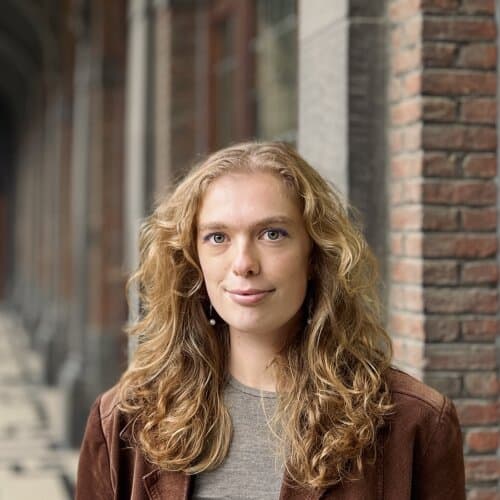
Fiona Holdinga (she/her) completed a bachelor’s and master’s degree in cultural anthropology at Utrecht University. Her research interests include the anthropology of morality and ethics, the nature/culture debate, the multispecies turn, and visual and sensory approaches. For the ReWorkChange project, she will conduct research in the Netherlands.